 How humans actually make decisions in complex, real-world settings is the study of naturalistic decision-making (NDM). Over the last several decades, NDM research has focused on answering questions regarding how we develop expertise and how we apply that expertise in order to make successful decisions in the real world. Application of NDM findings has met with positive results in a variety of fields including, but not limited to, fireground command, battle planning, critical-care nursing and event management.
2 Comments
Enjoying some time procrastinating, I found this video on YouTube that I thought did a pretty good job of summarizing the psychology of cognitive development. From Piaget to Vgotsky, the video covers a number of different researchers and experiments central to how our minds develop from children into adulthood. One method for solving problems is by using the acronym I.D.E.A. as a way to remember that to solve problems you have to Identify the underlying issue instead of the surface effects or symptoms, Develop solutions that target the underlying issue or root cause, Execute the solution by establishing and monitoring goals and then Assess the degree to which the solution has remedied the problem. Below is a short five-minute "how to" video that provides a brief overview of the I.D.E.A. model.  Making resolutions and setting goals are both strategies for change. Deciding which strategy is best depends on understanding willpower and the type of change you want to make or action you want to take. Research has demonstrated that willpower is a rather limited resource, but like a muscle it can be strengthened. Both resolutions and goals help us exercise our willpower, but there is a key difference. While most resolutions such as to no longer smoke are indefinite, goals such as to lose 10 lbs. are time-bound. This difference becomes important as you learn to exercise and strengthen your resolve. Why?
 At some point we have each hopefully experienced an insight, that “aha” moment when a key piece to a puzzle, problem, or question comes to mind, providing us with a valued flash of brilliance. Because experiencing an insight is typically helpful, most of us would like to know how we gain insights and is there anything we can do to get more of them?
 If you have never written a grant before, a good way to start gaining experience is by first finding funders that only ask initially for a letter of intent. Letters of intent (LOI) are usually limited to a few pages, allowing foundations to inform you if they have any interest in your idea, prior to spending a lot of time developing a full blown proposal. For new grant writers, letters of intent can be a simple way to introduce their work to the grant community.
When you write a LOI, look at it as a miniature version of a full grant proposal. Since the letter will be short there is no need to break the letter into multiple formal sections, but the letter still should contain material from each of the main components of a full proposal, just considerably reduced. Just like a full proposal your LOI should include in order; an overview/summary, introduction to applicant organization, the problem statement, methods, program outcomes, your evaluation plan, future support and budget. As with a full proposal the number one thing to keep in mind while writing is that it is not about you and your organization, it is about the funder. The goal in writing an LOI is to engage and connect with the funder, letting them know how what you are proposing pertains to them. Overview/Summary - write it last, but place it at the top of the letter to provide the funder an overview of what you are proposing. The first one or two paragraphs are the most critical of the LOI. It is the first thing the funder will read. Within the first two paragraphs a funder may already have decided if your organization and what you are proposing will be a good fit for their organization. Introduction to Applicant Organization - do not cut and paste your mission and/or vision. Be very strategic in connecting the funders organization to your organization. Reinforce similarities and disregard differences unless it is specifically this void your proposal is offering to fill. The Problem Statement - point out exactly what the problem is your organization has identified. Avoid jargon and technical terms. Engage the funder with the problem by including impacts in terms of facts as well as examples with which the funder can empathize. Create empathy. Methods - explain how you plan to address the problem. There is no need to get detailed. Provide the funder with a rough time estimate and very high level, key components your program intends to use. Program Outcomes - let the funder know the end results you expect to achieve. The easiest way is to relate outcomes to the key components described in your methods. The funder will be looking for both a reduction in the overall problem and more importantly, the funder will often ask themselves how the projected outcomes can be used to promote or market their own contribution to the project. Evaluation Plan - in an LOI the evaluation plan can be very short, only a sentence or two is needed. Basically you just want the funder to know you have thought about how success will be evaluated, either through surveys, tests, field observations, etc. Future Support - another short component within an LOI, you only want the funder to realize you have thought about what takes place after the program is finished and there no longer is any funding. A short paragraph that explains 'next steps', how the program will be sustained or how results will evolve into a new phase should suffice. Budget - unless you have a specific reason, avoid discussing the amount your proposal will potentially cost the funder. Instead, mention any commitments such as donated space, time or resources established with organizations relevant to the funder. For example, if the funder has a good relationship with the local community, mentioning leaders in the community have offered the use of the community center may add credibility. End your LOI by thanking the funder for taking the time to review your proposal while reinforcing how your organizations are a good match. Explain how you look forward to working with them and that you hope to hear from them soon. 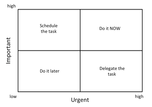 A well-known model for decision-making is the Eisenhower Matrix. It is not only a tool for prioritizing tasks, but for determining the correct action you should take to complete the task. Even if you are already familiar with the matrix, there are things you may want to consider that can help improve how the model is used.
|
Authors
Richard Feenstra is an educational psychologist, with a focus on judgment and decision making.
(read more) 
Bobby Hoffman is the author of "Hack Your Motivation" and a professor of educational psychology at the University of Central Florida.
(read more) Archives
April 2023
Categories |
 RSS Feed
Connect |

|
"Better decisions, better lives, better communities."
|
Copyright © 2009 - 2024, product of Richard LLC. All rights reserved.